We map the operation, then build the system that runs it.
Most owner-run companies arrive here the same way. The business grew, the tools did not, and the owner is the bottleneck. This page sets out how we replace spreadsheets with a system, when the business runs on spreadsheets, WhatsApp groups and one person’s memory, in the order it actually happens: the wall, the map, the operating system, the executive, the loop, and what changes for the owner.
The wall
Every growing company hits the same wall. Nothing moves without you. Every strand runs through one person, and growth makes it worse rather than better, because more revenue means more things only you can do. You will recognise most of this:
- The post-job debrief that never happens.
- The client nobody brings back at six months.
- The documents you hunt for every time someone asks.
- A group chat per project, and no way to see across them.
- No idea which channel the revenue came from.
- Work that waits, because only you can unblock it.
- A relationship that went cold, found by accident.
- A renewal you forgot, that blocked a job.
Your tools are fine. The problem is not the CRM or the accounting package or the project board. The problem is that all of it lands on one person, and some of it never arrives at all. These are the things that fall between the tools, and they are the same in a production company, a coaching business and a commerce brand.
When the owner is the bottleneck
The owner is the bottleneck because the operation lives in the owner’s head. The CRM is their memory. The pricing is their judgment. The quality bar is their attention. Every other person in the company can do their own job, and nobody but the owner can see the whole.
That is not a character flaw, and it is not a sign the business is badly run. It is the natural state of a company that was built by one person and grew faster than its systems. The owners we work with usually know it before we arrive, which is what makes the first conversation short. The question is not whether the operation needs to come out of one head. It is how to get it out without losing the things that made the business good, and that begins with writing it down.
The map: a real job, walked end to end
It starts in a room. We sit with the people who actually run the operation and walk one real job from first contact to the last thing that should happen afterwards. Not a questionnaire, and not a workshop about the future. One real production, one real sale, one real order, step by step, with the documents it generated and the people it passed through.
By the end of the day the operation is on the wall in order, with every point where something gets dropped marked on it. The debrief that never happens. The follow-up nobody owns. The quote that lived in a message thread. Owners tell us it is the first time they have seen their own business described in full, and that it was described better than they could have done it themselves.
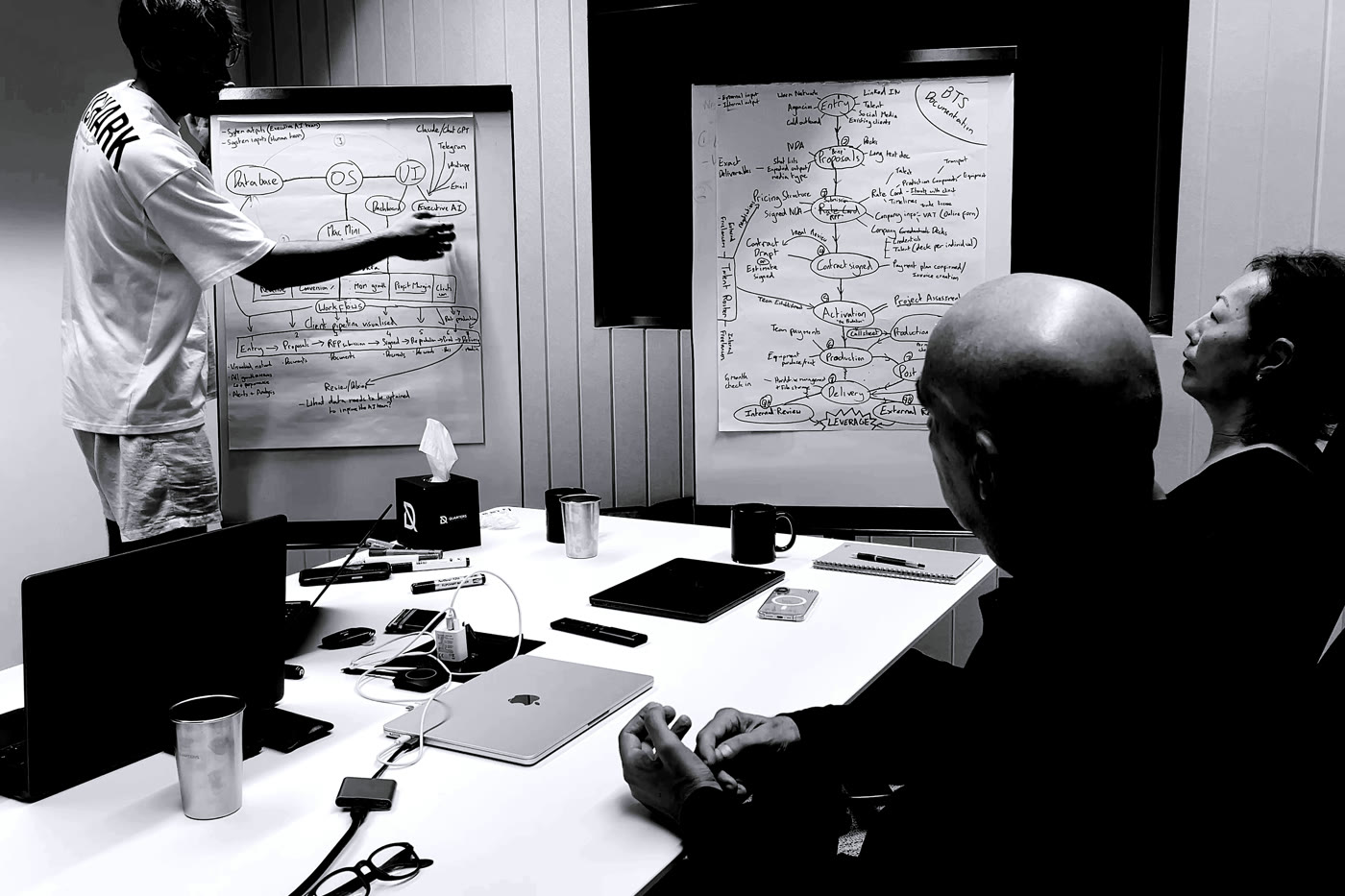
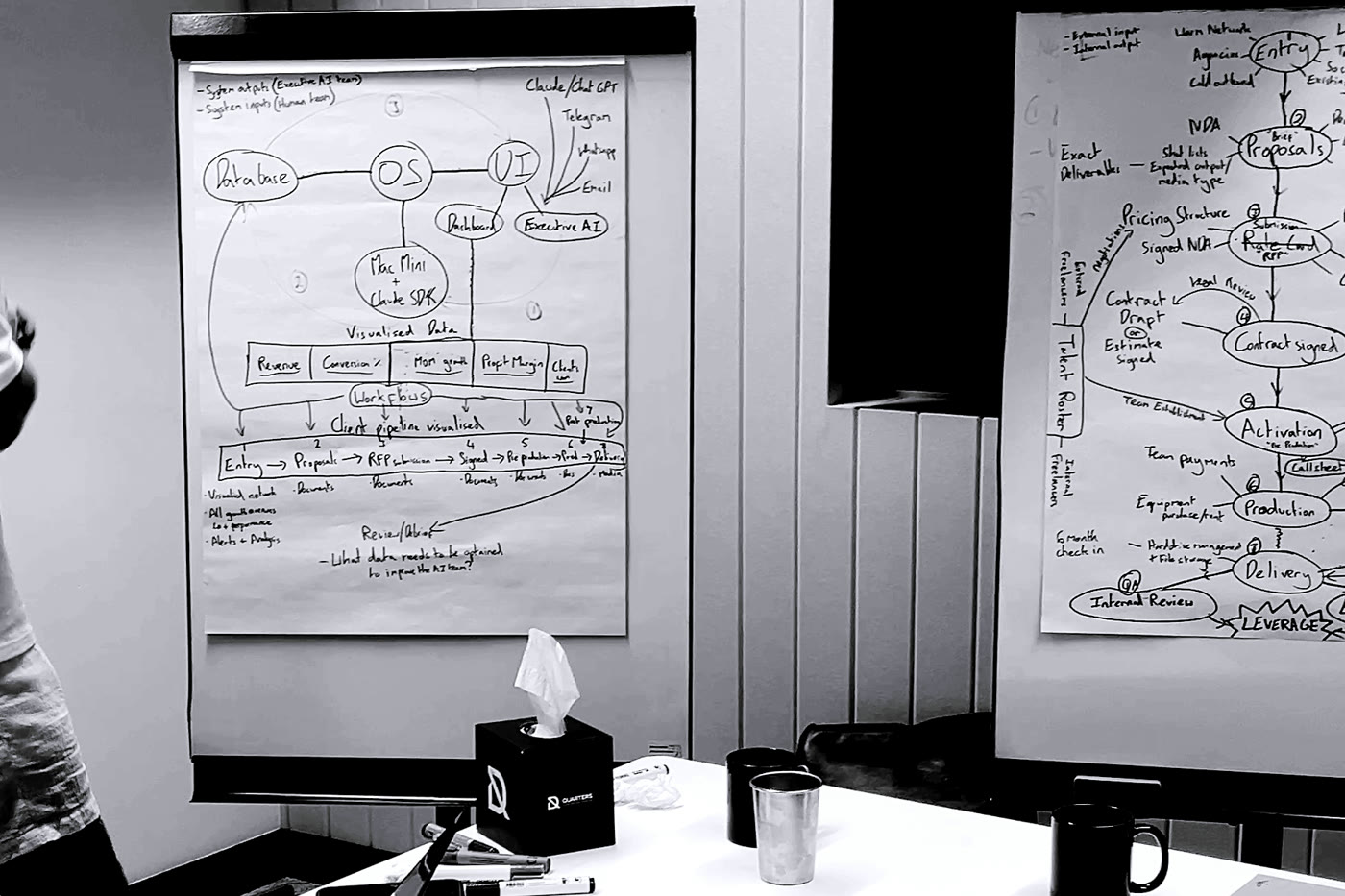
The Mandala mapping day in Dubai: a real production walked from the first call to the six-month follow-up, until the whole operation was on paper. Shown with the client’s permission.
The map is the most important thing we do, and everything after it depends on it. A system built without one is built around how someone imagines the business runs. A system built from one is built around how it actually runs, which is the only version the people inside it will use. The Mandala case shows the map that came out of that room.
Replacing the spreadsheets with a system: the Symbaiotic OS
Then we build the operating system. One system, in your brand, that every strand runs into, on your own infrastructure rather than a platform you rent access to. It replaces the spreadsheets, the group chats and the memory with a single place where the whole operation lives. Four parts, the same every time.
Pipeline
Every opportunity owned. Nothing unassigned, nothing dropped.
Work
Approved quote through to delivered, so plan and budget never diverge.
Money
Costs, pricing and margin, with what was predicted set against what happened.
People
Who is available, who is performing, what each person earns the business.
The four parts do not change between companies. What changes is the data inside them, the stages the work actually moves through, and which functions a given business needs first. A production company’s work part tracks briefs, crews and edits. A coaching business’s tracks calls, offers and onboarding. The architecture underneath is one product, which is why the second deployment is faster than the first. The operating system page describes each part and what it holds.
The executive: one executive, many hats
A system on its own is a better filing cabinet. What makes it run is a senior AI executive, and we build one, not many. Not a pile of bots handing work between them. One executive that changes hats, each hat with its own data and permissions.
Partner support
Triage, briefings, commitments, the daily brief
Finance
Costs, quotes, pricing, the margin
Delivery
Approved quote to delivered, without drift
People
Availability, performance, rates, who is booked
Sales
Prospects, follow-up, where the revenue came from
Every wild, unpredictable input goes to the executive: the enquiry at midnight, the supplier’s revised price, the crew member who is suddenly unavailable. One ordered line comes back to you, with what needs your judgment and nothing else. The executive absorbs the chaos.
It never speaks for you. It has no authority of its own. It does not commit the company, accept terms or talk to a client, and nothing goes out under your name without your review. Escalation triggers are defined for each hat before it is put on. Judgment stays human; the executive carries memory, speed and every strand at once. What agentic AI means sets this out in plain terms for an owner who has not met the idea before.
The loop
The last part is the one that makes the improvement compound. The things that never happen in a business run from memory, made structural, so they happen every time without anyone remembering to do them.
- Alerts before a deadline, not after.
- A debrief after every job, internal and with the client.
- A reason to call a past client at three months, and at six.
- What you predicted against what actually happened, every time.
- A flag the moment a relationship goes quiet.
This is where a business that runs without you comes from. Not from a dashboard, which shows you the problem and leaves you to carry it, but from a system that carries it and tells you only when it needs you. It is also the easiest part to demonstrate, because the owner already knows exactly which of these is not happening today.
What changes for the owner
The business stops routing through you. Enquiries have owners. Jobs are tracked from quote to delivery without you checking. The numbers reconcile themselves and tell you when they do not. Past clients get called at three months and six. You get a brief each morning with what needs your decision, in order, and the rest is already in hand.
What you keep is the part only you could ever do: the judgment, the taste, the relationships, the call on a difficult job. What you lose is the chasing. The operation lives in the system rather than in your head, which means it survives you stepping away, and it means the company can grow output without growing the number of things only you can do.
We work with a handful of companies at a time, and the first conversation costs nothing. You leave with our read on the real bottleneck either way. Three companies that have been through this are described under work in production, and the questions owners ask us most often are answered under questions owners ask.